Efficiency vs. Efficacy
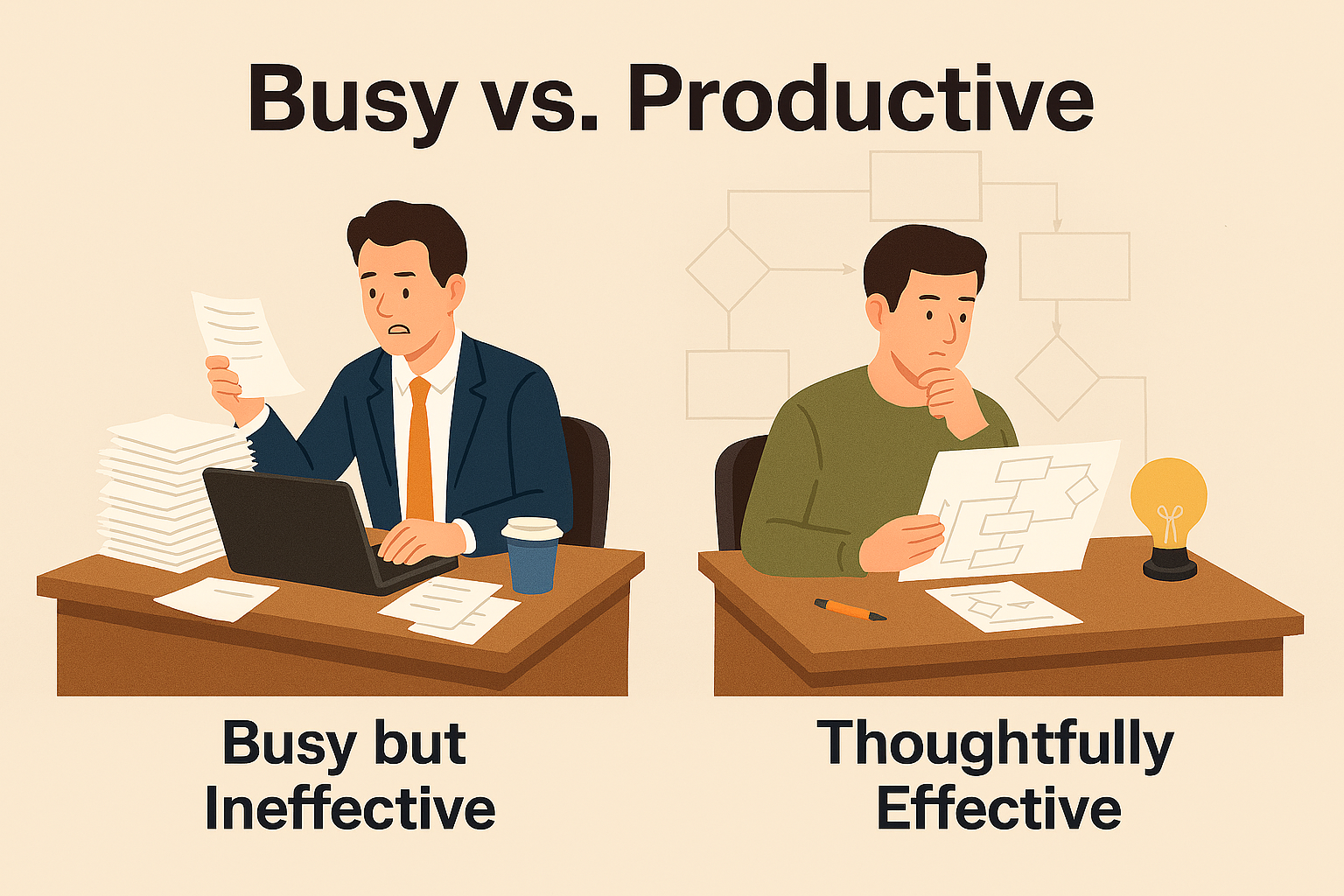
100% Efficient Makes You 0% Effective
Efficiency is easy to measure. Compare planned versus actual. If I set myself to start and finish a task in one hour, and I complete it in one hour, then I am 100% efficient.
But here's the catch: if that task was me doing nothing for one hour, have I really been effective?
The Illusion of Busy
Over the years, I've had countless debates with teams about this. We'd look at a process, and the team would proudly share their efficiency metrics. Everyone looks busy, or at least looks like they're following the steps.
On paper, it all seems perfect. But when you observe the process in action, it often feels like chaos. Things don't flow. Steps don't add value. People are working hard, but is the process working? Does it make sense? Is it effective?
Efficiency vs. Effectiveness
Here's the truth:
Efficiency is about doing things right. Effectiveness is about doing the right things. If you're 100% efficient at the wrong task, you're still 0% effective.
Efficiency is tangible. It's easy to measure. Effectiveness? Not so much. It feels intangible, and that's why it often gets ignored. But as leaders, that's exactly where our responsibility lies.
As Philip used to say: "You have a parking space, a company laptop, and a company-paid phone for a reason." That reason is to see what others might miss, to observe, and to make things better - not just faster.
Your Call to Action
Next time you review a process, don't just ask:
"Are we efficient?"
"Are we effective?"
Step back. Look beyond the numbers. Challenge the status quo. And here's a simple exercise to start:
- Map your processUse a Value Stream Map to visualize the actual flow and identify waste.
- The "GO SEE" PrincipleDon't rely on theory; observe the work where it happens to understand reality.
- The Disappearance TestFor each step, ask: "If this disappeared tomorrow, what would break?" If the answer is "nothing," you've found inefficiency disguised as work.
Efficiency matters. But effectiveness wins.